

Spondylolisthesis (Vertebral Slippage)
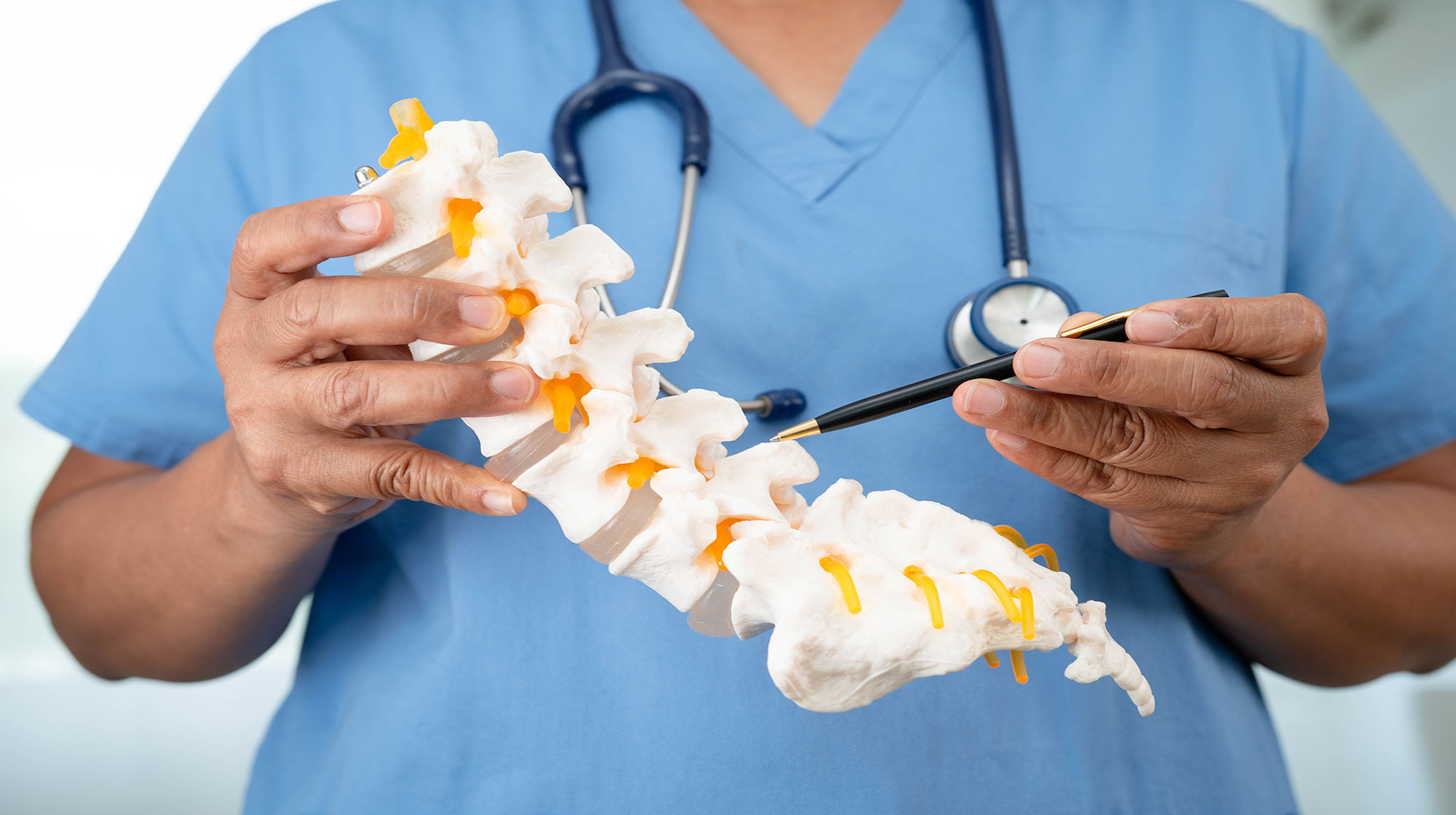
Spondylolisthesis is the forward slippage of one vertebra over the one below it. It most commonly occurs at the L4-L5 and L5-S1 levels. The degree of slippage is classified as Grade I-IV in 25% increments. It can cause low back pain, radiating leg pain, and walking difficulties.
What Is Spondylolisthesis?
Types of Spondylolisthesis
Isthmic Spondylolisthesis
Caused by a fracture or defect in the pars interarticularis bone region. Common in athletes and young individuals.
Degenerative Spondylolisthesis
Develops due to aging-related wear of discs and facet joints. More common in women over 50 years.
Congenital Spondylolisthesis
Caused by spinal anomalies present from birth.
Traumatic Spondylolisthesis
Develops from acute bone damage after accidents or falls.
Pathologic Spondylolisthesis
Results from bone weakening due to tumor or infection.
Symptoms
- Low back pain: Pain that worsens with activity and improves with rest
- Radiating leg pain: Sciatica due to nerve root compression
- Back stiffness: Particularly noticeable in the morning
- Hamstring tightness: Feeling of tightness in the back of legs
- Walking difficulty: Trouble walking long distances
- Posture changes: Increased or decreased lumbar lordosis
Diagnosis
- Physical examination: Palpable step-off, hamstring tightness
- X-ray (Dynamic): Instability assessment with flexion and extension films
- MRI: Disc, nerve, and soft tissue evaluation
- CT scan: Bone details, pars defect detection
Grading (Meyerding Classification)
- Grade I: 0-25% slippage
- Grade II: 25-50% slippage
- Grade III: 50-75% slippage
- Grade IV: 75-100% slippage
- Spondyloptosis: Over 100% (complete fall-off)
Treatment
Conservative Treatment
For low-grade and stable slippage:
- Physical therapy and core strengthening
- Pain relievers and anti-inflammatory medications
- Activity modification
- Epidural injections
- Brace use (short-term)
Surgical Treatment
For progressive slippage, severe pain, or neurological deficits:
Decompression + Fusion
Relieving nerve compression and stabilization.
Posterior Lumbar Interbody Fusion (PLIF)
Stabilization with cage and screws after disc removal from the back.
Transforaminal Lumbar Interbody Fusion (TLIF)
PLIF-like technique with unilateral approach.
Anterior Lumbar Interbody Fusion (ALIF)
Large cage placement through abdominal approach.
Lateral Interbody Fusion (LLIF/XLIF)
Minimally invasive fusion through lateral approach.
Reduction Surgery
Repositioning of vertebra in high-grade slippage cases.
Post-Operative Care
- Hospital stay: 2-5 days
- Brace use: 6-12 weeks
- Return to work: Office 4-6 weeks, physical work 3-6 months
- Fusion healing: 3-6 months
Why Choose Prof. Dr. Salim Şentürk?
Prof. Dr. Salim Şentürk has extensive experience in spondylolisthesis treatment. He determines the most appropriate treatment approach for each patient and applies modern surgical techniques.
Learn Your Slippage Grade
Schedule an appointment for detailed evaluation with your X-ray and MRI images.
Frequently Asked Questions
Does spondylolisthesis progress?
Degenerative type typically progresses slowly. Isthmic type may progress during growth periods in children. Regular follow-up is important.
Can I exercise?
Low-grade slippage allows activities like swimming and walking. High-impact sports should be carefully evaluated.
What is the surgery success rate?
With proper patient selection and technique, success rates of 85-95% are achieved.
Other Treatments

Spine Surgery
Surgical treatment of spine and spinal cord diseases

Deformity Surgery
Deformity surgery is the surgical correction of scoliosis, kyphosis, and spinal imbalance. Effective treatment is achieved with modern techniques and implants. Prof. Dr. Salim Şentürk's expertise in complex deformity surgery.

Endoscopic Spine Surgery
Endoscopic spine surgery is a minimally invasive technique performed through an 8 mm incision. Same-day discharge and rapid recovery are possible for lumbar and cervical disc herniations. Prof. Dr. Salim Şentürk's endoscopic surgery expertise.
Peripheral Nerve Surgery
Peripheral nerve surgery treats nerve compressions, injuries, and tumors. Carpal tunnel, cubital tunnel, and nerve tumors are treated surgically. Prof. Dr. Salim Şentürk's nerve surgery expertise.
Reviewed by: Prof. Dr. Salim Şentürk, Neurosurgeon
Last updated: